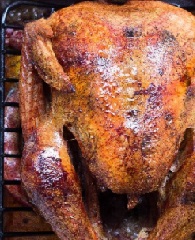
The short answer: roast a whole chicken at 350°F (175°C) for about 20 minutes per pound, plus 15 minutes. A 4 lb (1.8 kg) chicken takes about 1 hour 35 minutes. It is done when a thermometer in the thickest part of the breast reads 82°C (180°F), the temperature Health Canada gives for whole birds. Let it rest 10 to 15 minutes before carving.
Thanksgiving this year is Monday, October 12, 2026.
Why roast a chicken instead of a turkey?
Thanksgiving is one of our favourite holidays: time with friends and family, and the menu. The traditional turkey dinner is wonderful, but it is not always the right fit. A whole turkey is a lot of bird for a small gathering, it can be hard to find close to the holiday, and a 16 lb turkey can take up to 5½ hours to roast.
A roast chicken solves all three. It feeds four to six, whole chickens are in stores all year, and an average bird is ready in about 1½ hours. Serve it with all the usual sides: stuffing, gravy, mashed potatoes and cranberry sauce. Here is one of our favourite roast chicken dinner menus.
Your Thanksgiving weekend plan
- By the Friday before: buy or pick up your chicken. Thanksgiving Monday is a statutory holiday in Ontario and many stores are closed, and the weekend is the busiest time to shop.
- If it's frozen: move it to the fridge as soon as you get it home. It needs 24 hours for every 2.5 kg (5 lb) to thaw.
- The day before: make the cranberry sauce, prepare the stuffing and the vegetables, and bake any pies.
- On the day: take the chicken out of the fridge 30 minutes before roasting, roast it, and make the gravy while it rests.
How many chickens do you need?
Plan on about 1 lb (450 g) of whole chicken per person, a little more if you want leftovers. One 4 to 5 lb chicken feeds four, two feed eight, and three feed a table of twelve.
Roasting two chickens at once works well. Use the same temperature, leave space between the birds so the hot air can move around them, and allow 15 to 20 minutes more than for one. Check each bird with the thermometer: they rarely finish at exactly the same time.
How long to roast a chicken
At 350°F (175°C), for a thawed, unstuffed chicken. Always check with a thermometer: ovens and birds vary.
| Chicken weight | Roasting time at 350°F (175°C) |
|---|---|
| 3 lb (1.4 kg) | about 1 hour 15 minutes |
| 4 lb (1.8 kg) | about 1 hour 35 minutes |
| 5 lb (2.3 kg) | about 1 hour 55 minutes |
| 6 lb (2.7 kg) | about 2 hours 15 minutes |
How to roast a chicken, step by step
- Thaw it in the fridge, never on the counter. Health Canada's rule is 24 hours for every 2.5 kg (5 lb), so a frozen chicken needs about a day.
- Don't rinse it. Rinsing raw poultry splashes bacteria around the sink and counter. Pat it dry with paper towel instead, which also gives crispier skin.
- Season it with oil or butter, salt and pepper, and herbs such as thyme, rosemary or sage. A halved lemon and a few garlic cloves in the cavity add flavour.
- Roast it breast side up on a rack or on a bed of sliced onions and carrots, using one of the two methods below.
- Check the temperature in the thickest part of the breast, not touching bone: 82°C (180°F) for a whole bird.
- Rest it for 10 to 15 minutes under loose foil, so the juices settle before you carve.
Stuffing: the safest way is to bake it in a separate dish until it reaches 74°C (165°F). If you stuff the bird, stuff it loosely just before roasting, and take the stuffing out as soon as the chicken reaches 82°C (180°F).
Two roasting methods
1) Regular method
- Preheat the oven to 350°F (175°C).
- Roast the thawed chicken for 20 minutes per pound, plus 15 minutes.
2) High heat method, for a crispier, darker skin
- Preheat the oven to 450°F (230°C) and roast the thawed chicken for 10 to 15 minutes.
- Reduce the heat to 350°F (175°C) and roast for 20 minutes per pound. Do not add the extra 15 minutes of the regular method.
Methods adapted from Allrecipes.
Faster: spatchcock the chicken
Spatchcocking means cutting out the backbone with kitchen shears and pressing the chicken flat. It cooks faster and more evenly, and every piece of skin crisps. Roast a flattened 4 lb chicken at 425°F (220°C) for about 45 to 60 minutes, until the thickest part of the breast reaches 82°C (180°F). Keep the backbone for the gravy or for stock.
Gravy from the drippings
- Pour the pan juices into a measuring cup and let the fat rise to the top for a few minutes.
- Spoon 2 tablespoons of the fat back into the pan over medium heat, stir in 2 tablespoons of flour, and cook for a minute or two.
- Whisk in the skimmed juices topped up with chicken stock to make about 1 cup (250 mL), scraping up the browned bits.
- Simmer for about 5 minutes until it thickens, then season with salt and pepper.
A halal Thanksgiving
If you are hosting guests who eat halal, a halal-certified whole chicken is often much easier to find than a halal turkey, and it roasts exactly the same way. Look for a recognised certifier's mark on the package, and keep it apart from any non-halal meat while you cook. Our article on what it means when chicken is labelled halal explains the certification in Canada.
Roasting chicken thighs instead
For a quicker dinner, roast bone-in, skin-on thighs at 425°F (220°C) for about 35 to 45 minutes, until they reach at least 74°C (165°F), Health Canada's temperature for chicken pieces. Thighs stay juicy even a little past that. See our post on white meat vs dark meat for why.
Leftover roast chicken ideas
- Chicken soup or stock from the carcass, simmered with onion, carrot and celery
- Sandwiches and wraps with cranberry sauce
- Chicken pot pie with the leftover vegetables and gravy
- Fried rice, pasta or a quick chicken salad
Refrigerate leftovers within 2 hours of cooking and eat them within 2 to 3 days, or freeze them. Reheat to 74°C (165°F). Our chicken cooking temperature guide has more detail.
What Thanksgiving means
Thanksgiving in Canada is, at heart, a harvest festival. Indigenous peoples here were celebrating the fall harvest long before Europeans arrived. Martin Frobisher's crew held a thanksgiving in the Arctic in 1578, and the settlers of New France under Samuel de Champlain followed in 1606. The first annual national Thanksgiving was held on 6 November 1879, and since 1957 it has fallen on the second Monday in October, proclaimed as "a day of General Thanksgiving to Almighty God for the bountiful harvest with which Canada has been blessed."
For a family farm in the Holland Marsh, the harvest was never an abstract idea, and neither was the gratitude. However your family marks the day, in faith, in tradition or simply around a full table, it is a good moment to thank the people who grow and raise our food, and to share with neighbours who need it: your local food bank is always busiest in the weeks around the holidays.
Read about the history of Thanksgiving in Canada in The Canadian Encyclopedia, and support our own community's Helping Hand Food Bank in Bradford West Gwillimbury, which has fed local families since 1991 and now offers halal food too. Elsewhere in Canada, Food Banks Canada can point you to the one nearest you.
Where to buy your chicken
For over 60 years Cericola Farms supplied chicken for holiday tables like these: conventional, organic, antibiotic-free and animal by-product free. Those products are no longer available. Cericola Farms' plants have been part of Maple Leaf Foods since 2018 and 2021.
Today, choose any local chicken source you trust: a butcher, a farmers' market or a nearby farm, and order a whole bird ahead of the holiday weekend. Look for Canadian-raised chicken. However you celebrate, a meal shared with friends and family is always something to look forward to. Happy Thanksgiving.